
As millions of people around the world cut down their household waste for Plastic Free July, let’s explore what else is being done to minimise problematic plastics.
Plastic can take decades or centuries to break down, and some products may never fully decompose. This leaves us with litter in our environment, microplastics in our food, and landfills or incinerators leaching harmful greenhouse gases into the atmosphere and toxins into our soil and water.
There are ongoing collaborative international efforts to ban these dangerous single-use plastics and curb new plastic production. In 2022, representatives from 175 nations (including Australia and New Zealand) endorsed a United Nations resolution to end plastic pollution that will consider plastic production caps and advancements in end-of-life solutions.
The phase-out of single-use plastic items is also a key goal of the Australian Packaging Covenant Organisation’s 2025 National Packaging Targets. While their latest report found plastic minimisation targets are not on track to be met by 2025, their ambitions are still driving positive change, including a 28 percent reduction in priority single-use plastic packaging between 2017-18 and 2020-21.
Below are some of the items already or soon-to-be banned across Australia and New Zealand. States and territories have their own single-use plastic phase-out plans (plus some city-specific bans), so be sure to check what’s being cut where you live.
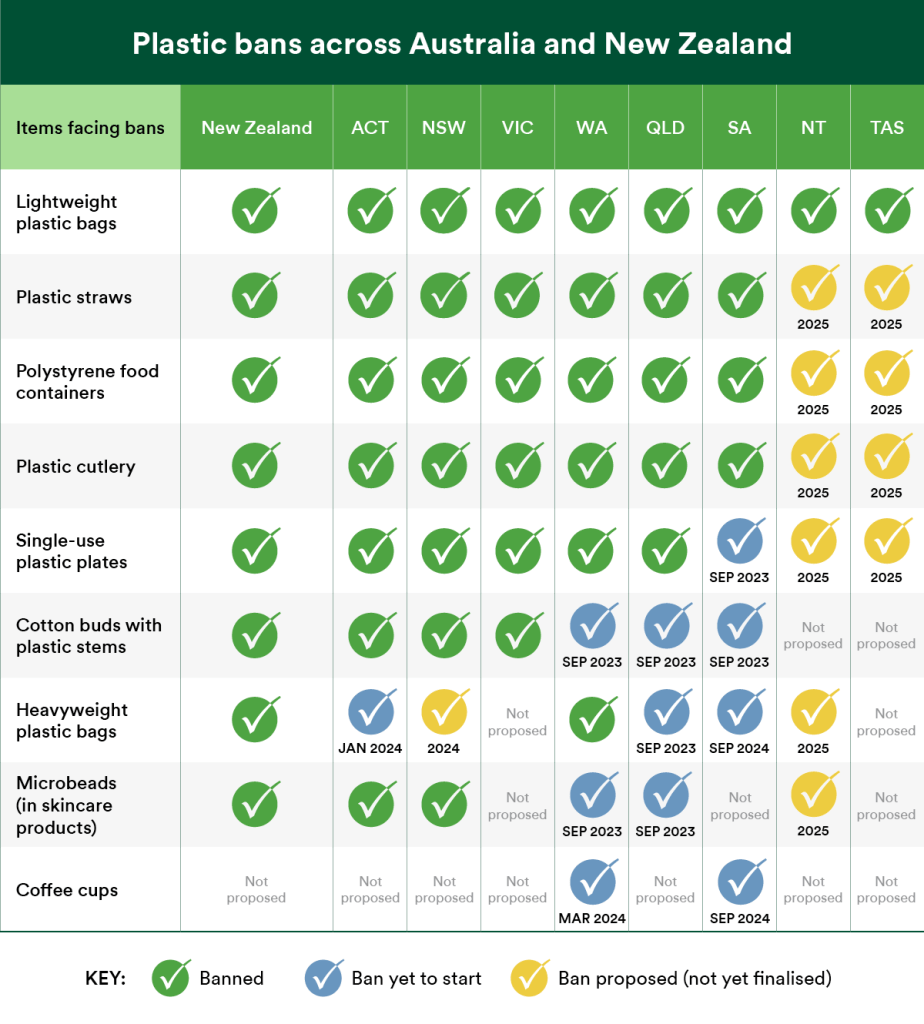
Table updated 3/07/2023
There are caveats to some of these bans, as well as exceptions to ensure equal access is maintained for people with disabilities. But cutting the bulk of these products out of the waste cycle is a step in the right direction.
Find more details about plastic bans where you live:
- New Zealand (national ban)
- Australian Capital Territory
- New South Wales
- Victoria
- Queensland
- South Australia
- Western Australia
- Tasmania (and the City of Hobart ban)
- Northern Territory
Use TerraCycle’s free recycling programs in Australia and New Zealand to responsibly dispose of yet-to-be banned problem plastics and other rubbish that isn’t accepted in kerbside recycling.
 TerraCycle News
3 thoughts